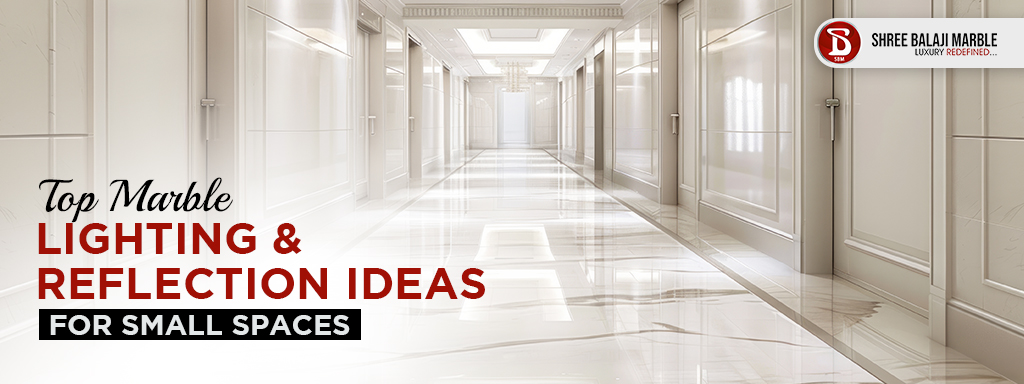
Top Marble Lighting & Reflection Ideas for Small Spaces
Small rooms ask a very specific question of the materials inside them: do you add to this space, or do you diminish it? The surface that most clearly determines the answer to that question operates through its ability to control light throughout the room. Marble, uniquely among all natural materials, does not just receive light. It moves light throughout its structure.
Architects and interior designers have understood this for a long time. The reason marble has appeared in some of the world’s most celebrated interiors, from intimate residential bathrooms to gallery-like corridors, is not just about prestige. The combination of natural stone patterns with various lighting systems creates depth and spaciousness, which painted walls fail to achieve.
The opportunity for compact homes and apartments is considerable. The actual performance of marble reflectivity in small rooms requires understanding its use beyond decorative purposes.
The Science Behind Marble’s Relationship with Light
Polished marble has a crystalline surface structure that reflects light differently from all artificial materials. The surface shows changing reflectivity because light hits it from different angles. The design creates an optical illusion that makes the wall or floor surface appear to extend beyond its actual boundaries.
The main foundational rule of marble lighting ideas for small spaces exists as the primary guideline for their implementation. The stone functions as a lighting element in that it requires existing light sources to operate, while enhancing and spreading their illumination throughout the area. A single well-placed pendant lamp above a marble surface will cast reflected light in multiple directions, which results in better room illumination than what the fixture could provide.
The marble’s visual properties, which include its color and veining patterns, create the specific effect that emerges from this material. White and cream marbles, such as Statuario or Onyx White, produce the most dramatic brightness amplification. Silver Travertine and other grey marbles create a mirrored effect which maintains a cooler and more subtle appearance. The decision should depend on the existing daylight levels that enter the space.
Where to Apply Marble for Maximum Spatial Impact
For designers, material selection holds equal importance as placement within a project. A complete marble wall behind a bed or sofa creates a visual path that extends throughout the wall, making the room appear larger. A light-toned marble floor that runs through narrow corridors creates an unbroken visual path because it eliminates the disruptive effect of grout lines and different flooring materials.
The global interior design market is projected to reach USD 175.74 billion by 2030, growing at a CAGR of 4.3% from 2025, according to Grand View Research. Space optimization is now among the primary drivers of residential design spending. That shift is visible in how designers are specifying materials: reflective natural stone in compact spaces is no longer a luxury preference but a considered spatial strategy.
The bathroom applications offer the most profitable returns for marble interiors in small spaces design. A compact bathroom reaches total visual openness through its use of floor-to-ceiling marble. The combination of matching floor and wall stone creates an effect where people experience room expansion because they cannot see room boundaries. The transformation achieves a dramatic effect when it combines with a backlit mirror and wall-mounted fixtures.
Backlighting and Translucent Stone
Certain marble varieties, particularly Onyx, have sufficient translucency to be backlit. The backlit Onyx panel functions as an installed feature panel because it contains LED strips, which produce a glow that appears as both a light source and a surface material. In small living spaces or boutique bathroom designs, a single backlit Onyx panel functions as both the ambient lighting source and the focal design element, eliminating the need for multiple fittings that would otherwise crowd a compact ceiling.
This is one of the more technically considered marble lighting ideas available, and the effect is genuinely difficult to replicate with any other material.
Choosing the Right Finish to Brighten a Home with Marble
The finish applied to marble changes its reflective behaviour when compared to its original state. Polished finishes produce the strongest light reflection and are ideal for floors and feature walls in rooms with limited natural light. Honed finishes absorb slightly more light and produce a quieter, more diffused glow that suits bedrooms and intimate living spaces better than the direct brilliance of a polished surface.
The design of a brightened home with marble needs a combination of polished flooring and honed wall cladding, which should use the same stone or a matching stone. The combination creates a design that exists in the background yet maintains its visual impact, which serves as the main difference between high-quality interior design and expensive interior design.
Shree Balaji Marbles provides various natural stones, which come in different finishes, enabling designers and homeowners to choose both the stone and its finishing touch as their sole material selection.
What This Means for Your Next Space
The small room, which uses appropriate marble for its design and includes dedicated lighting and spatial elements that were carefully planned, still maintains its original dimensions. The space shows signs of careful planning. The design process handles room size restrictions in a manner that creates spaces that maintain focus while achieving greater refinement than rooms that were filled with unassigned objects.
Natural stone is one of the few materials that rewards careful placement over generous quantities. A single well-chosen slab in the right location, under the right light, can redefine how an entire room feels.
Homeowners and designers who work in compact spaces need to assess whether marble will suit their projects. The true value of marble in any space is ultimately determined by how thoughtfully it is placed and lit.